A Financial Manual
The middle-decade math that quietly separates the wealthy from the merely well-paid.
Add $23,000 a year to your net worth without earning a dollar more, using the same thirteen levers I've watched actually-wealthy people run for a generation — now written down. Thirteen chapters, eight printable appendices, no gurus, no coaching upsell. Whether you're 21 with your first paycheck, 34 realizing you're behind, or 55 wondering if it's too late, the arithmetic is the same.
What this actually is.
Not a course. Not a mastermind. Not a "system." A single illustrated PDF you read once, work through, and keep forever.
A 13-chapter illustrated PDF plus eight printable appendices, written for anyone from 20 to 60+ who's earning something and can't shake the feeling that the account isn't compounding fast enough. It's the manual I wish someone had put in my hand at 32 — the boring, quantified, decade-by-decade version of what I've watched the actually-wealthy do, and what the people I know who stayed broke on high incomes never did. Every claim carries a dollar figure. Every chapter ends with a checklist you can run on your own numbers over a Sunday afternoon.
Two people, same salary, thirteen years later.
Before / after the same person, run against ninety days of the book. The gap is the book.
Both earn $110,000. Both are 34 today. Both live in the same city. One reads this manual on a Sunday and moves on eight items in the following ninety days. The other keeps doing what everyone at the office is doing.
| At age 47 | Reader A · default | Reader B · after ch. 1–5 |
|---|---|---|
| Net worth | $121,000 | $486,000 |
| Retirement runway if quit today | 2.4 yrs | 9.8 yrs |
| Effective tax paid over 13 yrs | $312,000 | $243,000 |
| Lifestyle inflation drift | +41% | +7% |
| Passive income (annual) | $0 | $21,400 |
| Delta | — | + $365k |
Numbers pulled from the chapter-1 worksheet. Your inputs will differ. The gap is not a promise — it's what the same salary produces when the middle decade is played on purpose.
Net thirteen-year delta: $365,000 — same job, same paycheck, same city. Just ninety days of the fixes, then thirteen years of leaving them running.
Thirteen chapters. Each ends in a checklist.
The full table of contents. Read in order or jump to the one that's already keeping you up at night.
| 1 | The compounding trap of the middle decade | 18 pp |
| Why 34-to-47 is the decade that decides, and the exact cost of losing a year of it — with the calculation you can run on your own account balances. | ||
| 2 | Twelve things millionaires quietly stopped buying | 22 pp |
| Not lattes. The category-by-category audit of where mid-tier income leaks — new cars, upgraded phones, "small" subscriptions, house-poor square footage. | ||
| 3 | The high-income illusion | 17 pp |
| The tax-and-lifestyle math that keeps $180k earners broke, and the seven behavioral rules that separate wealth-builders from wealth-signaling. | ||
| 4 | Looking broke on purpose | 15 pp |
| The everyday cover for building assets without triggering the social pressure to inflate. Includes the "invisible millionaire" wardrobe, car, and neighborhood test. | ||
| 5 | The money lies your parents taught you | 19 pp |
| Six inherited beliefs that made sense in 1978 and are actively costing you money now. Debt-fear, home-ownership-as-savings, tenure-as-safety, and three more. | ||
| 6 | Small habits that compound into serious wealth | 20 pp |
| The nine mechanical routines — most take under fifteen minutes — that account for most of the gap between Reader A and Reader B in Section III. | ||
| 7 | Why "saving money" is making you broke | 16 pp |
| The mathematics of the high-yield savings account trap: how a "safe" 4% costs you against inflation, and the four asset shifts to make with your emergency fund. | ||
| 8 | Historical wealth cycles — what 2008, 2020 and 2026 have in common | 21 pp |
| The three windows in the last twenty years when ordinary people got rich — and the specific market signals that were the same each time. Position for the next one. | ||
| 9 | Debt — the difference between a tool and a chain | 18 pp |
| The three categories of debt every earner has and can't tell apart. The rate/tax/leverage framework for deciding which to eliminate this quarter and which to keep for another decade. | ||
| 10 | The taxes you're leaving on the table | 23 pp |
| Fourteen deductions, credits and structural moves W-2 earners consistently miss. Written for people who don't have a CPA on retainer. | ||
| 11 | Investing psychology, and why smart people underperform | 19 pp |
| The three cognitive traps that let engineers and doctors lose to a target-date fund. The rules that a boring investor uses instead — and the one active position worth taking. | ||
| 12 | The primary-residence trap | 17 pp |
| Why "the house you live in" is the least useful asset you own, the correct rent-vs-buy math for the current rate environment, and when a paid-off mortgage is a mistake. | ||
| 13 | The fifteen-year plan — working backwards from freedom | 15 pp |
| The reverse-engineered net-worth ladder for calling your own shots by 55. Milestone by milestone, with the exact allocation and cash-flow numbers at each rung. | ||
Read this manual if any of the following are true.
A short diagnostic, then three readers who ran it. If more than one applies, the book is for you.
| 1. | You're between 20 and 60+ and your total net worth is less than three times your annual income. |
| 2. | Your salary has gone up faster than your investment balance in the last five years. |
| 3. | You have never once sat down and calculated how many years of runway your account represents. |
| 4. | You suspect that "just keep saving in the 401(k)" is not, actually, going to be enough. |
| 5. | You've bought a personal finance book before, read the first two chapters, and put it down when it turned into a lifestyle brand. |
I'm 39. I make good money. I kept looking at my Vanguard balance and thinking: this is not the number I should have. This book is the first one that told me the exact reason without turning into a pitch for a course.
Repositioned $94k · projected 15-yr +$340k
I'd been saving 10% for eight years and had nothing to show for it. Ran the tax-loophole checklist over one weekend. Found $11,400 I was leaving on the table every year.
Reclaimed $11.4k/yr in tax capacity
Twenty-two years old, my first paycheck, and instead of buying the car I'd been planning I set up the automatic transfer from Appendix C. Not a car I'd want to drive today anyway. First hundred grand at 29.
$0 → $102k in 7 yrs on a mid-range salary
The book that would have paid for itself in your first quarter — for $47, one time.
Get the Manual · $47→Michelle "Mitch" Lane.
Money Mitch on YouTube. San Diego. Not a CFA, not a fund, no affiliate links inside the PDF.

My name is Michelle Lane. Everyone calls me Mitch. I'm in my mid-thirties, based on the West Coast of the US, and I'm the person behind the Money Mitch YouTube channel — thirteen-minute videos about the boring mechanics of wealth-building for people who missed the first two decades of the game. This manual is the compact, indexed, offline version of the material I've spent three years testing on the channel, minus the algorithm's rewards for click-hooky thumbnails.
I'm not a CFA. I don't sell financial products. I don't run a fund, and there are no affiliate links inside the PDF. What I have is the exact playbook I ran on my own finances starting at 27, when my brokerage app told me my "responsible saver" plan was going to leave me poor, and I decided to figure out what the actually-wealthy people I knew were doing differently. This book is the answer I wish someone had put in my hand at that age.
It is not an instruction set for becoming rich overnight. It is an instruction set for keeping more of what you already earn — and letting the arithmetic do the rest.
If a claim carries a dollar figure, there's a citation in the endnotes. If a strategy is beyond my competence, I say so and point you at the specialist you actually need. That's the whole tone.
$47 once. No subscription. Yours forever.
Instant download — in your inbox within 60 seconds of payment. Read on any phone, tablet, or computer. Print at the kitchen table if you want.
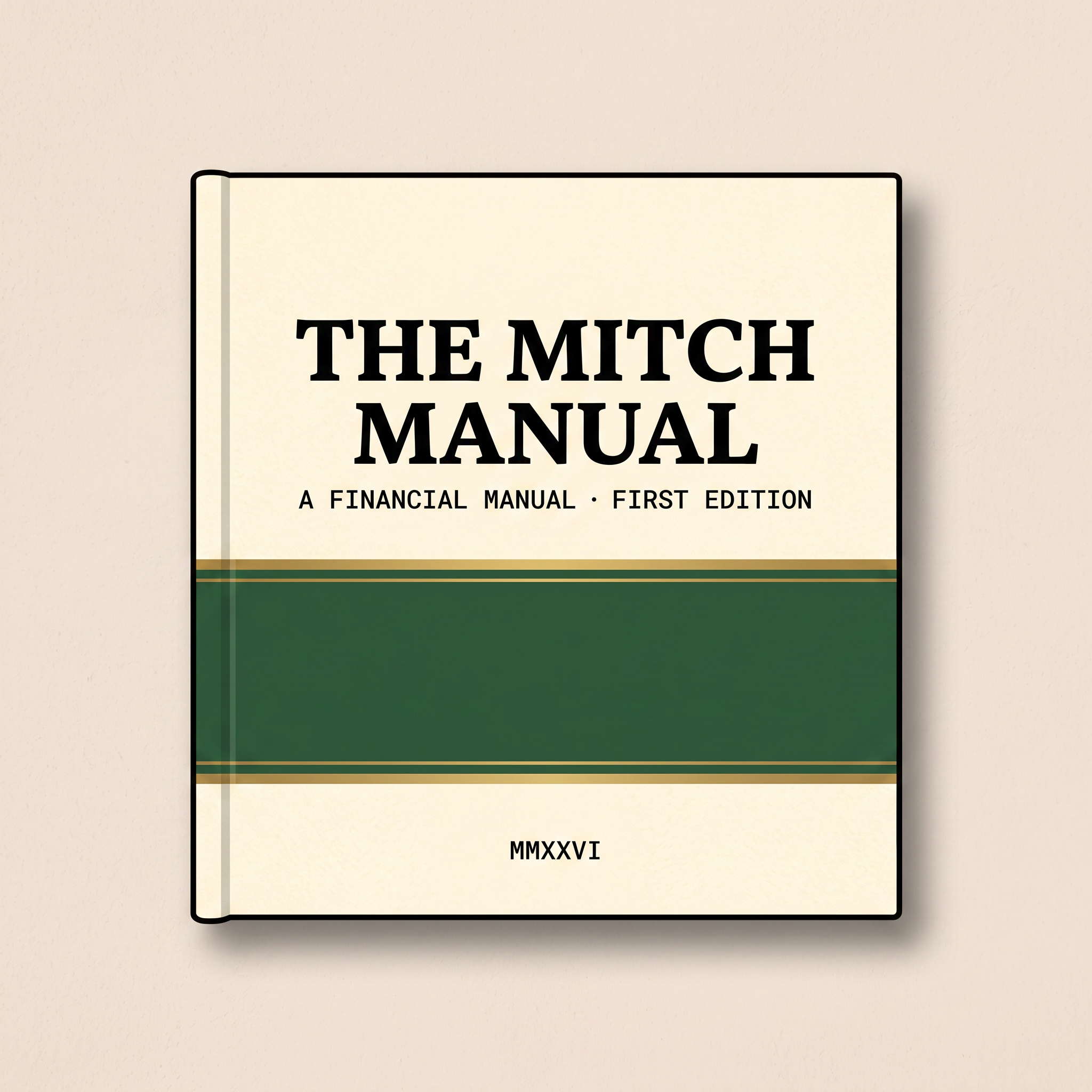
First edition · MMXXVI
The Mitch Manual, first edition Core
The illustrated PDF. Thirteen chapters, eight printable appendices, seventy-four worksheets and checklists. Every future revision free for life.
| The Mitch Manual — 13-chapter illustrated ebookFirst edition, revised MMXXVI. Delivered as one PDF, bundled with the four bonuses below. | $47 |
| The First-90-Days Money Reset Three fixes to earn the $47 back before the quarter closes. Ships as Appendix C inside the ebook. | $19 |
| The Middle-Decade Ledger Printable net-worth + cash-flow tracker, 7-rung ladder + tempo forecast. Ships as Appendix A inside the ebook. | $19 |
| The Tax-Loophole Checklist for W-2 earnersFourteen deductions, credits and moves salaried earners consistently miss. Ships as Appendix E inside the ebook. | $14 |
| Lifetime updatesEvery future revision, free — the book is a living document. The download link that arrives on purchase always points at the latest edition. | $21 |
| Total value | $120 |
| You pay today | $47 |
Objections, answered plainly.
The six questions I get most often after Money Mitch videos. If yours isn't here, reply to the receipt — I read every one.
Is this another "personal finance" book like all the others?
I already earn well and have a 401(k). Will there be anything new here?
Is it US-specific?
Will you be running a course? A community? A coaching program?
I'm 55 or 60 — am I too late for this?
What happens after I pay?
Add $23,000 a year to your net worth — without earning a dollar more — with the Method I teach.
$47 once. Thirteen chapters, eight printable appendices, seventy-four worksheets. Instant download. No subscription, no coaching, no follow-up funnel. Read it once, work through the fixes, keep the compounding forever.
Get the Manual · $47→ Secure Checkout · Pay once · Yours forever · Every future update, free